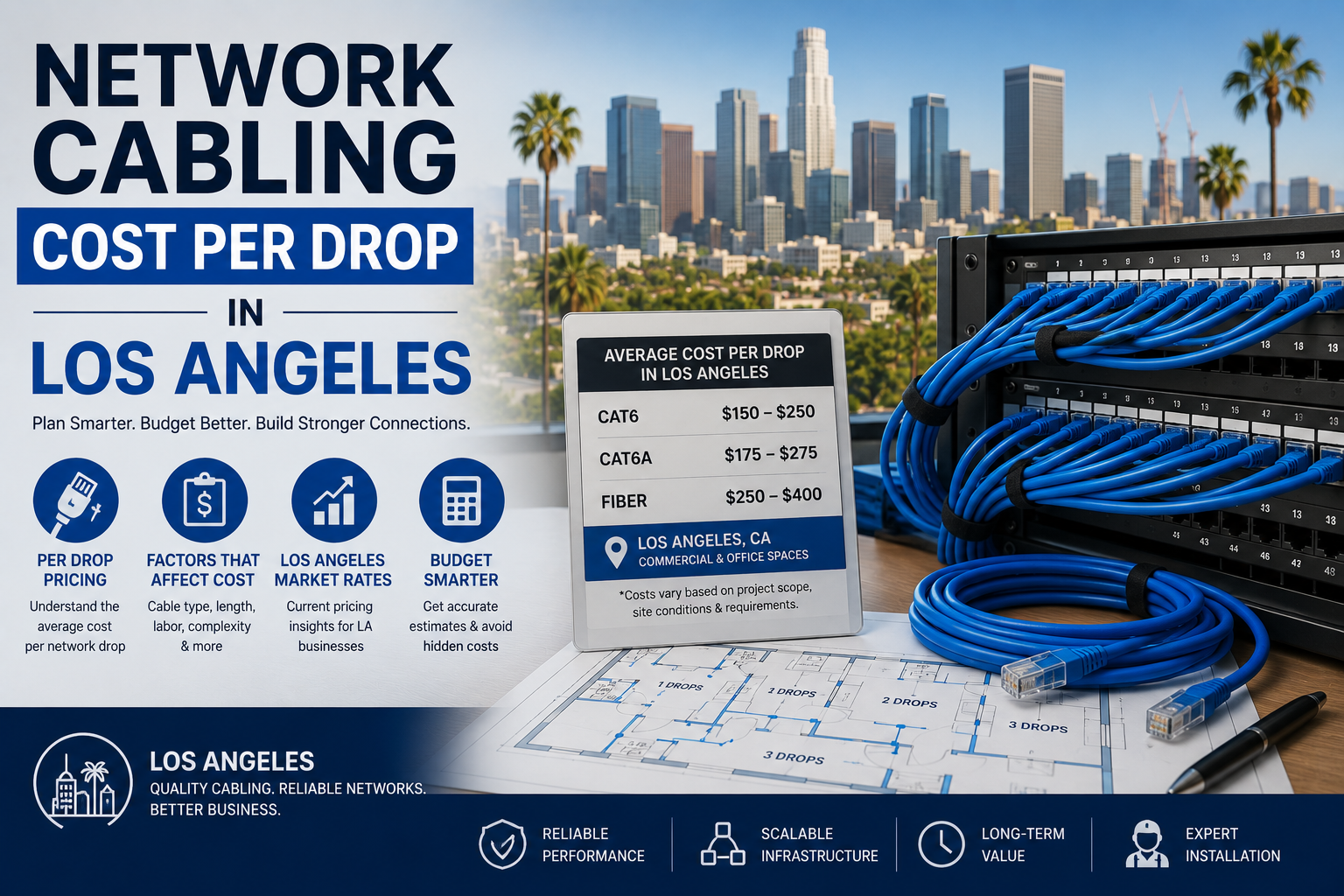
Network cabling in Los Angeles typically costs $150 to $350 per drop for standard Cat6 in a commercial office. Cat6a runs $200 to $450. Most 25-person offices land between $6,000 and $15,000 for a complete installation including the rack, patch panels, testing, and certification. Difficult ceilings, long runs, and conduit requirements push it higher.
“Per drop” means one cable run from your network rack to one endpoint — a desk, an access point, a camera, a printer. Twenty desks with one connection each is twenty drops.
Here’s what moves that number, and how to tell a fair bid from a bad one.
What’s actually in a per-drop price
A legitimate quote covers:
- The cable itself
- Labor to pull it through walls and ceilings
- Termination at both ends
- The wall jack and faceplate
- Patch panel termination in the rack
- Testing and certification of each run
- Labeling at both ends
- Cleanup
If a bid is dramatically cheaper than the others, something on that list is missing. Usually testing and certification — which is exactly the part that proves the work was done right.
What drives the price up
Building type
Open ceiling, modern office — cheapest. Cable trays already there, easy access.
Drop ceiling — standard. Most commercial LA offices. Moderate.
Hard ceiling / drywall — expensive. Every run means cutting, fishing, and patching.
Historic buildings — a real factor in LA. Older Pasadena, Downtown, and Long Beach buildings often have plaster walls, asbestos considerations, and landmark restrictions. Costs can double.
Concrete or tilt-up — common in industrial areas like Vernon, Commerce, and the Inland Empire. Core drilling adds substantial cost.
Distance
Ethernet has a 328-foot limit. Long runs in warehouses or multi-suite offices may require intermediate distribution frames, which adds equipment and labor.
Conduit requirements
Some LA jurisdictions and many building owners require cable in conduit. It’s not optional where it applies, and it can add 30% to 50%.
Ceiling height
Warehouse and industrial ceilings need lifts. That’s equipment rental plus slower work.
After-hours work
Many buildings only permit cabling work outside business hours. Expect a premium.
Cat6, Cat6a, or fiber?
Cat6 — $150–$350 per drop
Handles 1 Gigabit easily, 10 Gigabit up to about 165 feet. Fine for most offices today.
Choose it when: standard office use, budget matters, you’re not planning heavy 10-Gig deployment.
Cat6a — $200–$450 per drop
Full 10 Gigabit at the complete 328-foot distance. Better shielding.
Choose it when: you’re doing significant video or file work, deploying Wi-Fi 6E or 7 access points, or you expect to be in the space more than five years.
Worth knowing: the cable is maybe 30% more expensive. The labor is nearly identical. Since labor dominates the cost, upgrading to Cat6a on a new install is often a modest increase — and pulling cable again later costs full price.
Fiber — $300–$800+ per run
For backbone connections between floors, buildings, or IDF closets. Not typically run to individual desks in a normal office.
Choose it when: connecting between floors or buildings, exceeding 328 feet, or you need very high bandwidth on the backbone.
Real-world example ranges
These assume standard drop ceiling and reasonable access:
Small office, 10 people, 15 drops Cat6, basic wall-mount rack: $3,500 – $6,500
Mid-size office, 30 people, 45 drops Cat6a, floor rack, patch panels, certification: $11,000 – $20,000
Warehouse plus office, 25 drops with access points Mixed environment, high ceilings, lift required: $9,000 – $18,000
Medical or dental practice, 20 drops Cat6a, additional runs for imaging equipment and cameras: $7,000 – $14,000
Wide ranges, deliberately. Building conditions swing these more than anything else. Any contractor quoting confidently without a site visit is guessing.
Don’t forget what goes with it
The cabling is one line item. A complete job usually includes:
- Network rack or wall-mount cabinet — $300 to $2,500
- Patch panels — $100 to $400 each
- Cable management — $200 to $800
- Switches — highly variable by port count and features
- Wi-Fi access points — $200 to $800 each installed, and each one needs its own drop
- UPS — $300 to $2,000
Ten questions before you accept a bid
- Is testing and certification included, and do I get the report?
- What category cable, and what brand?
- Are jacks, faceplates, and patch panel termination included?
- Are you licensed and insured in California? (Low-voltage work generally requires a C-7 license.)
- Who pulls permits, if required?
- Is the rack and cable management included or separate?
- What’s the warranty on labor and materials?
- Will everything be labeled at both ends?
- Do you provide as-built documentation?
- What happens if you find asbestos or an unexpected obstruction?
That last one matters more in LA than most places. Older buildings hide surprises, and you want the change-order process agreed before someone opens a ceiling.
The mistakes that cost money later
Cabling for today’s headcount. Add 25% to 30% spare drops. Pulling extra cable during the initial install costs a fraction of coming back later.
Forgetting the access points. Every Wi-Fi access point needs a drop, and it needs to be in the ceiling where coverage is best — not wherever’s convenient.
Skipping certification. Without a test report you have no proof the runs perform to spec. When something intermittent breaks in eighteen months, you’ll have no baseline to argue from.
No labeling. Unlabeled cable turns every future change into a guessing game with a tone generator.
Ignoring the closet. Beautiful cabling terminating into a chaotic, unventilated closet is a problem waiting to happen. Power, cooling, and physical security matter.
Separating cabling from network design. The cable is infrastructure for a network someone has to design and run. Handling them as unrelated projects is how you end up with perfect cabling into a switch that can’t support what you bought it for.
Frequently asked questions
How much does it cost to cable a 25-person office in LA? Typically $6,000 to $15,000 for standard Cat6 in a normal drop-ceiling office, including rack and certification. Difficult buildings run higher.
Is Cat6a worth the extra cost? On a new installation, usually yes. Labor dominates the price and doesn’t change much, so the upgrade is often modest — while re-cabling later costs full price.
Do I need a permit for low-voltage cabling in Los Angeles? It depends on jurisdiction and scope. Many low-voltage jobs require permits, particularly with conduit or fire-rated penetrations. Your contractor should handle this — ask before work begins.
How long does cabling take? A 20-to-30 drop office is usually one to three days with a standard ceiling. Difficult buildings or after-hours restrictions extend it.
Can I run the cable myself? Technically for a very small setup, though commercial buildings usually require licensed contractors, and fire-rated penetrations must be properly sealed. Uncertified cable also creates warranty and insurance complications.
Should I cable or just use Wi-Fi? Both. Wi-Fi access points need cable to reach them, and anything stationary and bandwidth-heavy — desktops, servers, printers, cameras — performs better wired.
Get a fixed quote after a real site visit
Cabling estimates given over the phone are guesses. We walk the space, check the ceiling and pathways, plan for growth, and give you a fixed written quote.
WinC Services — structured cabling, network installation, and managed IT across Los Angeles and Orange County. Based in Pasadena.
📞 (213) 855-3506
Related reading: